Accelerating MiniMax H3 carefully: signed EasyCache sweeps and audiovisual gates
How app.nz tests H3 denoising caches with private signed controls, fixed-seed A/B jobs, runtime telemetry, and first/last-frame, audio, and loop quality gates.
Listen to this article
On-device voiceUses the voice built into your browser; no article text leaves this page.
Audio narration is not supported by this browser.
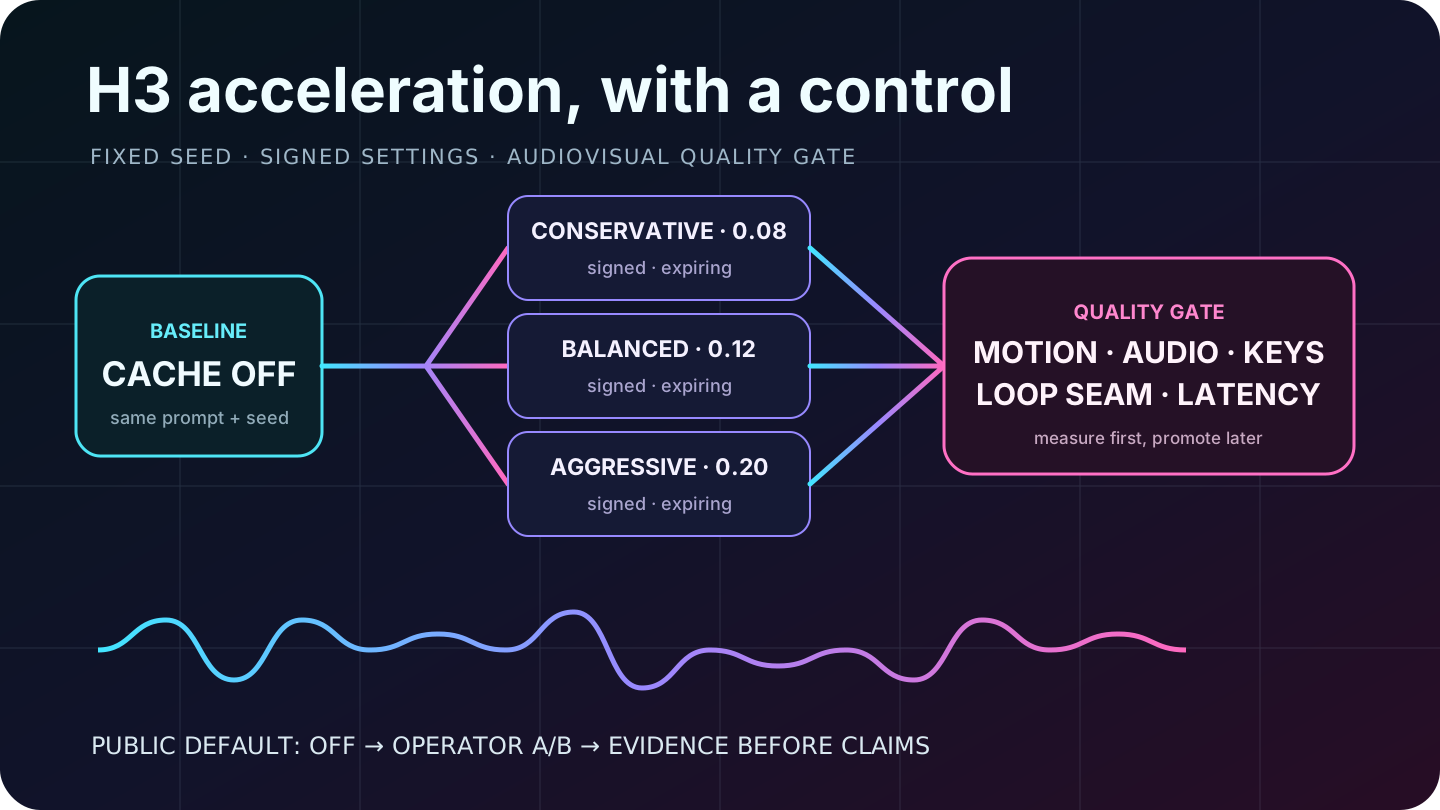
Video acceleration is easy to overstate. A cached denoising step can make a benchmark faster while quietly weakening motion, synchronized audio, the final keyframe, or a loop seam. For our open-source MiniMax H3 Cog, the safe default is therefore still the full official sampling path. We have now added a private, reproducible way to test a cache without turning an experiment into a public quality promise.
The implementation is in github.com/lee101/h3-cog.
Why EasyCache is the first candidate
The pinned ComfyUI build already contains an EasyCache node. It wraps the model used by both H3's guider and scheduler, then decides whether intermediate model work can be reused during a configurable portion of sampling. The current implementation also handles list-shaped joint latent inputs, including separate video and audio tensors. That makes it a plausible H3 experiment, not proof that any threshold is quality-safe.
We did not add a generic “latent teleport” switch. There is no compatible latent-teleport node in the pinned native H3 stack. We also left CG-Taylor out: moving a cache designed around another diffusion family into H3's joint audiovisual stream would require its own integration and evidence.
The source of truth is ComfyUI's built-in EasyCache documentation and the exact ComfyUI commit pinned by the container—not an assumed speedup from a different model.
Public API off, operator sweeps on
Cache controls do not appear in the website, Cog schema, CLI, desktop app, or MCP tools. Those surfaces remain in parity and run uncached. The private RunPod handler accepts an operator envelope only when all of these checks pass:
- HMAC-SHA256 signature from a server-only
H3_TUNING_SECRET - expiration no more than one hour away
- an allowlist of fields and short, safe sweep identifiers
- reuse threshold between
0.00and0.30 - a valid start/end window inside the denoising schedule
The signature and secret are never returned or logged. A missing envelope is the ordinary lossless baseline; a partial or modified envelope fails closed.
One command, four comparable jobs
Start with a request JSON that fixes the prompt, keyframes, dimensions, step count, and seed. The repository's sweep tool emits an uncached baseline plus three short-lived signed candidates:
| candidate | reuse threshold | active window | intent |
|---|---|---|---|
| off | — | — | quality and time baseline |
| conservative | 0.08 | 20–80% | small first move |
| balanced | 0.12 | 15–90% | broader reuse test |
| aggressive | 0.20 | 15–95% | upper comparison, not a default |
export H3_TUNING_SECRET="$(openssl rand -hex 32)"
python h3_sweep.py request.json --sweep-id gallery-a01 > sweep.json
Every response reports total, generation, and AV1 encode time; exact seed; dimensions and frame count; output byte size and SHA-256; and the non-secret cache configuration. That is enough to join results without trusting filenames or eyeballing which clip came from which job.
The quality gate is audiovisual
For each candidate we compare against the same-seed uncached render in VisualBench and retain the original output. A candidate is rejected when it introduces any of the following:
- subject, face, text, or fine-geometry drift;
- weaker motion, new flicker, or temporal discontinuity;
- speech, effects, or music losing synchronization;
- first- or last-frame alignment regressing;
- a more visible seam in true loop mode.
The seven-shot launch suite covers text-to-video, image-to-video, first/last-frame interpolation, a generated loop, vertical, square, and ultrawide framing. We will report median and tail latency separately for each mode after the licensed GPU run. Right now there is intentionally no “H3 is N× faster” number: the control plane, signing, workflow routing, RTX 5090 AV1 path, and telemetry are tested, but an H3 cache speedup is not established until the weights can be run in a license-eligible region.
What can ship before a cache wins
Several optimizations do not alter H3's denoising result: keep the ComfyUI process warm during a burst, store verified weights on a persistent RunPod volume, use preview canvases for iteration, avoid unnecessary re-encoding, and use Blackwell's AV1 encoder for delivery. Scale-to-zero still removes idle GPU cost, while app.nz displays the selected RunPod rate plus the stated 80% platform fee.
Once a cache candidate clears the suite, it can become an operator-selected deployment profile with its measurements attached. It will not silently become the public default. Explore the H3 catalog preview or read the packaging and license note.