MiniMax Music: BF16 vs FP8, then Opus vs AAC vs MP3
Six fixed-seed Music3 renders, ten controlled codec encodes, open Cog source, and the audio players to judge them yourself.
Listen to this article
On-device voiceUses the voice built into your browser; no article text leaves this page.
Audio narration is not supported by this browser.
We open-sourced the production wrapper at github.com/lee101/minimax-music. It is a typed Cog with fixed seeds, 10–300 second bounds, scale-to-zero GPU deployment, and WAV, FLAC, Opus, or MP3 delivery. The MIT repository contains the wrapper and experiment tools—not the MiniMax weights, which keep their own model terms.
Deploy MiniMax Music on app.nz, or inspect the full machine-readable study manifest.
First, a correction: this is BF16 vs FP8
The serving stack supports a BF16 autoregressive backbone or an FP8-quantized backbone. Its acoustic DiT and DAV decoder remain BF16 in both profiles. There is no true INT8 Music3 path in the pinned backend, so calling the FP8 output “INT8” would be wrong.
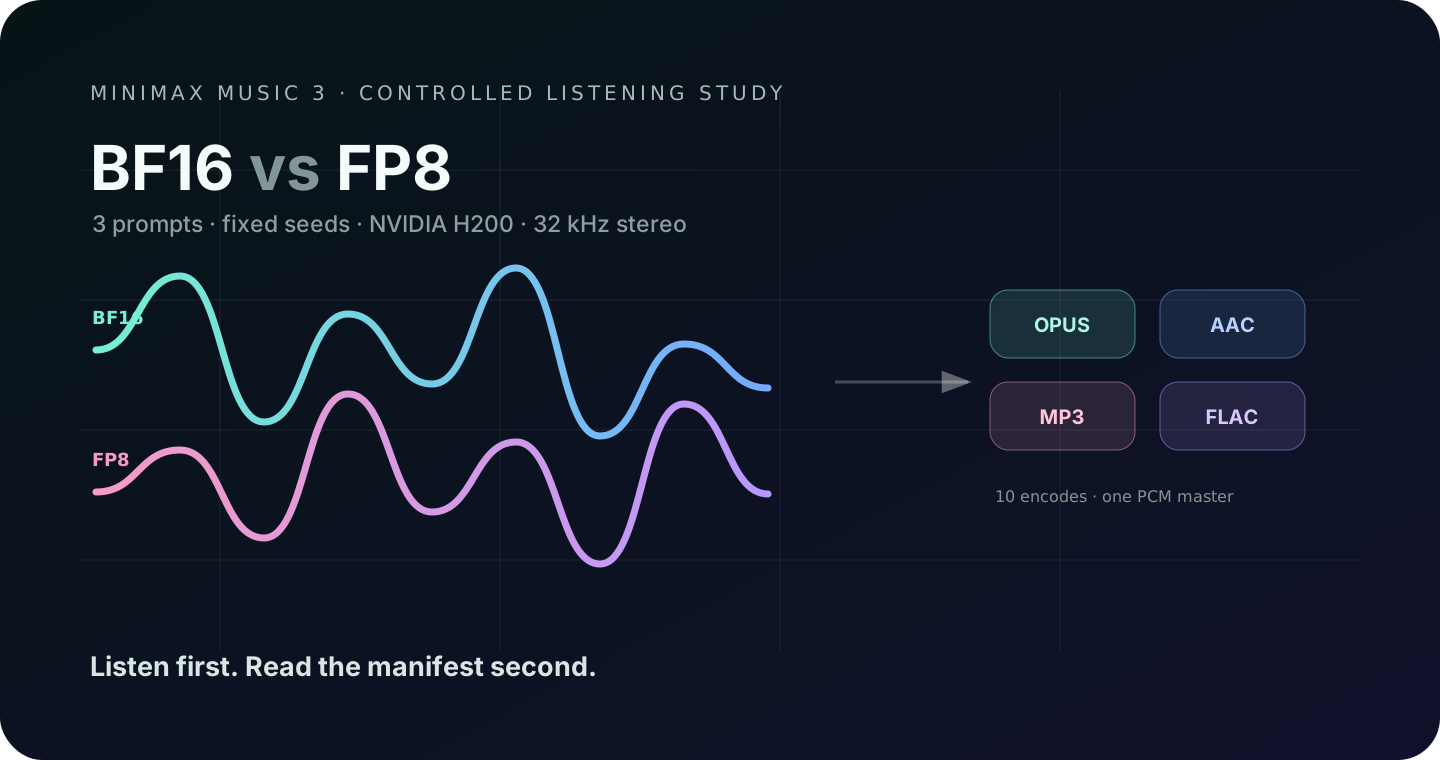
We deployed two immutable RunPod templates on NVIDIA H200, fixed the model, backend commit, prompt, structured lyrics, duration cap, and seed, then rendered three cases through both profiles. A seed controls sampling within one profile; quantization changes the sampling path, so BF16 and FP8 are different takes—not sample-aligned waveforms.
Across these three runs, median generation time per output second fell from 0.380 with BF16 to 0.345 with FP8, about 9.2%. Wall time is deliberately not the headline: cold queue and model-load time dominated several runs.
Listen: Neon Tide
Dreamy 108 BPM synth-pop with an intimate lead and wide chorus. Seed 2026082601; both outputs reached 30.023 seconds.
BF16 WAV master · FP8 WAV master
Listen: Dust and Wire
Cinematic desert blues at 92 BPM with tremolo guitar, cello, brushes, and a weathered lead. Seed 2026082602; both outputs reached 30.023 seconds.
BF16 WAV master · FP8 WAV master
Listen: After Rain
Instrumental modern jazz trio at 124 BPM. Seed 2026082603. The model ended the BF16 take at 23.499 seconds and the FP8 take at 29.188 seconds, despite the shared 30-second cap. That is a real result worth preserving, not trimming away.
BF16 WAV master · FP8 WAV master
Codec listening ladder
Every file below comes from the exact same BF16 Neon Tide WAV master. There is no regeneration and no loudness normalization between encodes, so the only planned variable is the delivery codec and target bitrate. FLAC is the lossless anchor. File size is for this 30.023-second stereo track.
Opus
AAC-LC
MP3
What we can claim
- FP8 reduced median generation seconds per output second by about 9.2% in this three-case H200 run.
- All six masters are 32 kHz stereo PCM16 and reported zero clipped samples.
- The codec ladder is controlled from one PCM master, with hashes, FFprobe records, encoder settings, byte sizes, and EBU R128 scans in the manifest.
This is not an ABX study and three prompts do not establish universal audio quality. Listen on the same device at the same volume, hide the labels if you want a blind trial, and treat preference as preference.
The practical default remains FP8 for the production backbone and 128k Opus for browser listening, while archival outputs stay WAV. The open Cog keeps BF16 as a separate deployment profile for teams that want to run their own evaluation.