The next ten years: minds as products, machine-speed markets, and why big labs are the new big tech
Five clear 2026–2036 predictions for agent-built products, creative media, biology, robotics, and machine markets—and how app.nz plans to capture value.
Listen to this article
On-device voiceUses the voice built into your browser; no article text leaves this page.
Audio narration is not supported by this browser.
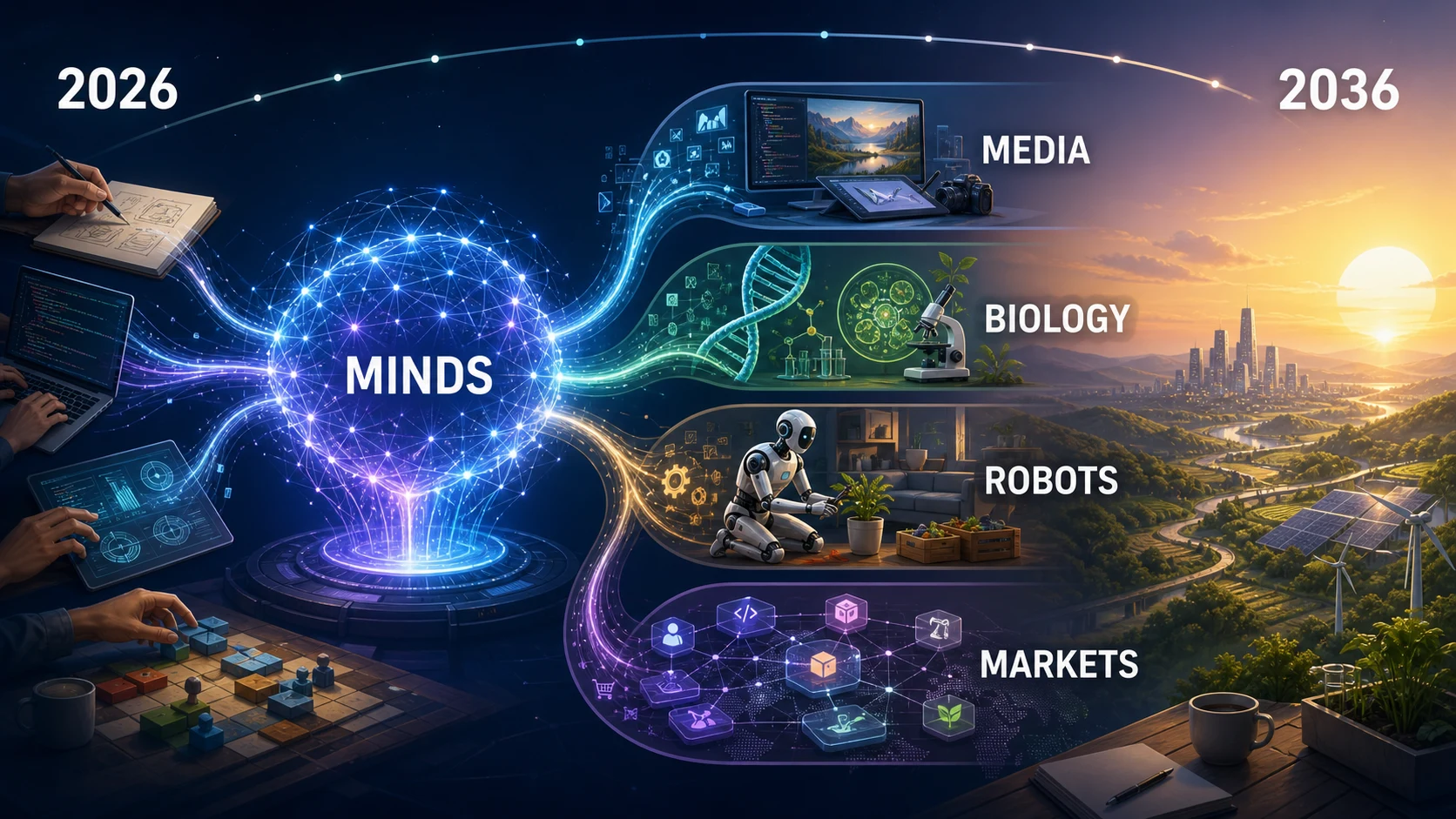
Ten years is a strange unit of time right now. It is short enough that most of the companies that will matter in 2036 already exist, and long enough that the frontier labs expect to pass systems "smarter than a Nobel Prize winner across most relevant fields" well inside it — that's Dario Amodei's phrasing in Machines of Loving Grace, and Sam Altman's Intelligence Age essay makes the same bet from the other lab. The forecasting community has gone further and published year-by-year scenarios like AI 2027. You can argue with the timelines; you can't argue with the direction, because the inputs are public: Epoch AI's data shows frontier training compute growing 4-5x per year for over a decade.
This post is our ten-year picture, and why app.nz is built the way it is: a platform where anyone can make anything — including minds.
Minds become a product category
The most under-priced idea in tech today is that a mind is now a thing you can assemble. Not "a chatbot" — a persistent entity with a personality, a memory, skills it has practiced, tools it is allowed to use, and a body it can wear, whether that body is a website, a game character, or a humanoid robot.
Every layer of that stack is already live on app.nz:
- Personality and identity — character editor, 3D characters and VRM avatars give an agent a face, a voice, and a consistent self.
- Skills and abilities — skills are packaged, versioned competencies; agents install them the way phones install apps, and the skills market lets builders sell them.
- Learning — hosted fine-tuning and RL mean a mind isn't frozen at deployment; it keeps getting better at its actual job.
- Agency — the agents SDK, auto agents, browser agents and MCP servers connect minds to the tools and data they need to act.
By 2036 we think "AI mind engineering" is a mainstream profession the way web development is today: composing personality, skill sets, memory policies and tool permissions into an entity, then shipping it into software, games, storefronts — and robots.
Robots get personalities, not just policies
Embodied AI stopped being only a research demo. DeepMind's Gemini Robotics 1.5 turns visual information and instructions into motor commands, Figure's Helix runs a single neural network across a fleet of humanoids, NVIDIA ships GR00T as an open foundation model for any robot body, and Unitree sells a capable humanoid, the G1, for the price of a used car. Goldman Sachs projects a $38B humanoid market by 2035.
Here is the part the hardware companies underweight: the robot is the cheap part. What families and businesses will actually pay for is who the robot is — its personality, its judgement, its accumulated skills, its relationship with the people around it. Hardware becomes the handset; the mind becomes the subscription. That software layer — characters, skills, memory, world models for training in simulation before acting in reality, animation and motion libraries for expressive movement — is exactly the layer app.nz builds.
Making becomes a default human ability
The near-term revolution is less theatrical: people stop needing permission to make software and media. A founder describes a product; agents implement, test, deploy, watch production, and continue. A musician or filmmaker directs an idea, then calls models for sound, images, motion, voices, and edits through one workflow.
That loop exists across our projects now. Codex Infinity runs continuous repository agents with --auto-next-steps and --auto-next-idea. ManifoldGen turns prompts and source media into finished music and video through app.nz Cog routes. The measured outputs in our infrastructure deep dive are not concept art: they are the files, timings, seeds, and manifests.
Our prediction: by 2030, a capable person with a good idea can build what took a small 2026 company. By 2036, the scarce inputs are taste, trust, distribution, proprietary feedback, and the courage to choose a problem—not the ability to produce the first version.
Markets go high-frequency and low-fee
When agents do the shopping, commerce changes shape. An agent doesn't buy a $99/month SaaS seat; it buys 40 milliseconds of GPU, one API call, one skill invocation, one dataset row — millions of times a day. The rails for this are being standardized right now: Google's Agent Payments Protocol (AP2), Coinbase's x402 reviving HTTP 402 for machine-native payments, and Stripe building agentic commerce directly into model providers.
Two things follow. Transaction volume explodes, and fees collapse — a 3% card fee is absurd on a $0.0004 purchase. The winning marketplaces will look more like exchanges than app stores: high-frequency, low-take-rate, machine-speed settlement. We run this model today at human scale: the model gateway meters every token across every provider with transparent low-margin pricing, prepaid credits settle usage instantly, and the skills market and gallery APIs are built agent-first — REST, CLI and MCP — because by 2036 most of our customers won't be humans.
Augmented humans, upgraded institutions
The utopian half of the decade is genuinely utopian. Amodei's essay sketches a "compressed 21st century" in biology — decades of medical progress in years. Brain-computer interfaces have left the lab: Neuralink has humans controlling computers by thought, and the crude versions of augmentation — an agent that remembers everything for you, negotiates for you, researches for you (our deep research is an early ancestor) — are already compounding into real cognitive leverage. Ten years out, "unaugmented" starts to feel like "offline" does today.
The biology merge begins before consumer brain implants. AlphaFold 3 predicts structures and interactions across proteins, DNA, RNA, ligands, and other molecules; its database already exposes more than 200 million predicted protein structures. Pair systems like that with cheaper sequencing, lab automation, wearables, and longitudinal health records and the loop tightens:
measure → model → propose → test → learn → personalizeOur positive prediction is not instant immortality. It is faster target discovery, more personalized prevention, better assistive devices, and far more science per researcher. Biology becomes an engineering surface while clinical validation and human consent stay the hard gates.
Government gets more intelligent too, and honesty requires saying that cuts both ways. The optimistic template exists: Estonia runs 99% of public services online on transparent data infrastructure, and Audrey Tang's Plurality movement shows AI strengthening democratic deliberation rather than replacing it. But states that can afford frontier compute will also see more than any state in history — ubiquitous sensors plus models that can actually read all the feeds is a surveillance capability, full stop. The interesting question for the 2030s isn't whether governments use AI; it's whether the auditing, the appeals process, and the citizen-side agents are as smart as the state-side ones. We think the answer depends on intelligence being cheap and broadly distributed rather than rationed by a few incumbents — which is an infrastructure question, and infrastructure is a thing you can build.
The big labs are the new big tech
Now the investor-relevant part. The defining business-strategy fact of this decade: frontier labs are becoming vertically integrated industrial companies, not software vendors. OpenAI's Stargate is a $500B commitment to own its own compute; every major lab now co-designs custom silicon, signs gigawatt power deals, and builds its own datacenters. Leopold Aschenbrenner's Situational Awareness called this early: the endgame is trillion-dollar compute clusters, and the labs intend to own the whole stack — chips, energy, datacenters, models, distribution, and increasingly the applications on top.
This is "big tech" rebuilt around a different core asset. Google was organized around the index, Meta around the graph, Apple around the device. The new giants are organized around intelligence per watt, and they integrate vertically for the same reason Standard Oil and Ford did: when your input is scarce and your margins live in the stack, you buy the stack.
We think this is simply what an ambitious AI business looks like now, at every scale — including ours. app.nz runs its own GPUs and serving stack (our own inference infrastructure, sub-5-second deploys, polyserve packing hundreds of apps into one process, our own embeddings answering searches in ~1ms). Owning the vertical means our unit economics improve with every optimization we write, instead of accruing to a cloud landlord — and it's why we can run low-fee, high-frequency pricing that resale-margin platforms can't follow.
Five predictions we can be judged on
| By | Prediction | Evidence visible now | Confidence |
|---|---|---|---|
| 2028 | Most new software has substantial agent-written code | Coding agents already edit repos, run tools, test, and open PRs | High |
| 2029 | Generative media is a normal production layer, not a novelty tab | Our Cog routes already return measured music and video artifacts | High |
| 2031 | Useful robots learn transferable skills across several bodies | Gemini Robotics reports cross-embodiment transfer; GR00T is open-weight | Medium |
| 2033 | Agent-to-agent purchasing is a meaningful software channel | Stripe ACP, Google AP2, and x402 are shipping rails | Medium |
| 2036 | AI-assisted biology shortens multiple discovery loops materially | AlphaFold-scale tools already move molecular work from search toward design | Medium |
These are directional bets, not promises. The dates can slip. The useful part is that each one suggests a product layer we can build and measure today.
How we plan to capture value
We do not need to predict the single winning model. We want to own the useful cross-model rails and participate every time an agent builds or runs something:
| Layer | What we have now | Why it compounds |
|---|---|---|
| Compute market | Gateway, Cogs, GPUs, metering, provider routing | More traffic improves routing data and utilization |
| Agent cloud | Tasks, skills, CLI, desktop, MCP, continuous modes | More work creates reusable skills, traces, and evals |
| Creation | Music, video, image, 3D, worlds, deploys | Every output can become an app, asset, or marketplace listing |
| Identity | Characters, memory, voices, avatars | Persistent minds create switching costs based on continuity, not lock-in |
| Markets | Credits, hosted apps, skills and asset surfaces | Machine-frequency transactions favor low-fee integrated rails |
The strategy is deliberately broad at the product edge and narrow underneath: one identity, one balance, one artifact system, one routing layer, and matching web, Go desktop, CLI, and MCP surfaces. If people can build almost anything, the valuable place to stand is where those things are built, run, improved, and sold.
The bet, in one paragraph
Over ten years: minds become products, robots become people-shaped software subscriptions, markets become machine-speed exchanges, humans and governments both get radically augmented, and the winners own their stack. app.nz is the place where a single builder — or a single agent — can make anything in that world: train it, give it a personality and skills, deploy it, embody it, and sell it, on infrastructure we own end to end. The labs are building the new heavy industry of intelligence. We're building the place everyone else gets to participate.
If that thesis matches your view of the decade, read the investor room and the long-form vision — every claim in them links to a live product route you can click today.
Sources
- Dario Amodei — Machines of Loving Grace
- Sam Altman — The Intelligence Age · Three Observations
- Leopold Aschenbrenner — Situational Awareness
- AI 2027 scenario · Epoch AI compute trends
- OpenAI Stargate announcement
- Gemini Robotics 1.5 · Figure Helix · NVIDIA GR00T · Unitree G1
- Goldman Sachs — humanoid robot market forecast
- Google DeepMind — AlphaFold
- Google AP2 · x402 · Stripe agentic commerce
- Neuralink · e-Estonia · Plurality